Squads

This year I grouped my fifth and sixth grade classes into squads and it has been a great management, motivational, and learning tool.

Each class (about 36 students) is divided into 4 squads of 8-10 students. Each squad has a team captain, a warm-up captain, and as-needed, another sport-specialist captain. When they arrive at class they immediately put on a jersey in their assigned color. The warm-up captain leads the small group in stretches and other exercises for about 8-10 minutes. They remain in their squad the entire class period, usually participating as a team in the activity.

What I love about this:
-The teams are already divided so no class time is used to organize.
-I give points everyday for students being dressed to move, listening to directions, following warm-up leaders, good sportsmanship, etc. Every 6 weeks the winning team gets a prize so they are motivated in any area I emphasize by giving out points.
-Leadership training: The team captains have been amazing and really watch out for their teammates. The love having jobs to do and responsibilities. I change the captains every trimester.
-Sports captains: I have assigned each captain a sport-specific captain as needed. For example, when we did a soccer unit, each team had a soccer captain. The soccer captain moved his/her team thru drills and helped teach. They did a great job and it is a fantastic outlet for the athletically advanced students.
-Set-up and clean-up: I can set-up while the groups are warming up on their own. Each group is assigned a clean-up job and they get points for doing a good job so clean-up has become fast and easy.
-Sportsmanship: I give out points for sportsmanship and they are also given the opportunity to give points to each other as they play games if their opponent demonstrates good sportsmanship. I hear a lot more compliments and positive feedback as they try to earn those points.

I could go on and on because this system has made my life so much easier and I am so impressed with the students’ abilities to lead and work together. It took a little training, but has definitely been worth the effort.


Scooter tip

I learned the greatest scooter tip at a collaboration meeting this week. I have always had trouble with the smaller children smashing their fingers when the scooter tips and they are holding on to the handles. Ouch! Another teacher suggested having them hold onto the seat; handles go out around the hand. It works great! If a scooter tips the handle actually protects the hand instead of smashing it. I used scooters today for the first time with kindergarten and had no smashed fingers.


Soccer Baseball

This game worked out great as a follow-up to work with soccer skills. Some previous lessons and practice with dribbling, trapping, and punting make it a productive game.

Game was set up on a baseball diamond. Instead of bases I used hula hoops on the ground, with the exception of home plate which was a standard cone. Fielding team played traditional baseball positions. Kicking team needs 5 soccer balls. First kicker comes to home plate with 2 balls. The first ball is punted (I let them drop kick or kick from the ground as they are comfortable). The 2nd ball must be dribbled to 1st base and trapped in the hoop before the fielding team gets the punted ball trapped in the base. No hands are allowed — kicks only. Next kicker again has 2 balls, one punted & one dribbled to base. Fielding team can get either player out by trapping the punting ball into a base hoop. Game continues with the possibility of 5 balls being in play at once (1 on each base, kicker with punted ball and dribbling ball). To score at home, the dribbled ball had to hit the cone before the punted ball. It was a good paced game with some real focus on the dribbling and trapping. Everyone had a chance to kick and practice. Baseball and soccer fans alike seemed to enjoy the game.
*note: I had 8 players on a team. I did not play 3 outs. Every player kicked and then teams rotated. Strongest punter should kick last as they person needed “home run” to score.


Steal the Flag – “football”

The school year is coming to an end and I am trying out some new games with my classes — just some fun, active stuff to end the year. Today my 5th and 6th grade classes played this game of steal the flag with a twist:
1. Nerf footballs were used instead of flags
2. Divide the class into two equal teams and give each team different color flag belts
3. Set up field into a large rectangle with 4 cones then mark a middle line with another two cones. place a football near one corner cone and another in the opposite corner. The other two corner cones will act as a “jail”.
4. Team #1 tries to steal the football from team #2 by crossing over to their side of the field and grabbing the ball without getting their flag pulled. They can run the football back or pass it to another team player.
5. If a player has his/her flag pulled while holding the ball, the ball is placed where the flag was pulled.
6. If a pass is made that is not caught, the ball goes back to its home spot at the corner cone.
7. When a player has his/her flag pulled they go to jail on the opposite team’s field. They can be rescued by another team mate touching their hand and walking them back.
8. If the football makes it to the opposing team’s field without a flag pull it is a point for that team and both footballs go back to the starting position.

Highlights:
The kids had a lot of fun playing and most stayed involved. The passing gave the traditional game a new twist. There was a lot of running and activity.

Troubleshooting:
I set the rule that the kids can’t “puppy-guard” the ball. They must stay at least 5 feet away. Still I always have a lot of arguing about this rule and one team thinking the other is too close, etc.


Rhythm sticks

I found 2 boxes of rhythm sticks in my closet and decided to try them out with my 1st and 2nd graders. It turned out to be a good activity for hand-eye coordination. I organized the class into a large circle with one stick per person. Then I went through the following sequence giving them time to practice each one before moving on:
1. spin stick in a circle on the floor with one hand
2. try spinning with your other hand, try reversing direction
3. toss stick from hand to hand
4. hold stick at eye level, let go and catch with the same hand before it hits the ground
5. flip stick and catch in the opposite hand
6. balance stick on 4 fingers, 3 fingers, 2 fingers, 1 finger, wrist, shoulder, knee

After the sequence I assigned all the children a partner and had them sit on the floor with legs extended in a “v”, feet touching. I gave each partnership a tennis ball and had them use the stick to pass the ball back and forth to each other.

Something new, challenging, lots of things you could try . . .


“Scooter Town”

This was a fun activity culminating our scooter work. It also brought back some favorites and allowed for some exploration of activities we don’t really have time to try. I did it with my 3rd and 4th grades and they LOVED it. I ended up doing it 2 weeks instead of 1 just because they begged so much. It worked like this:

I made a sign that said “scooter town” and taped it to a cone set up in the front of the room. I then set up 4 activity stations (basketball, tumbling mats, balls & paddles, hula hoops). Each station had a ticket value (2-4 tickets) and was labeled with a sign. A fifth station was for earning tickets which was done by completing exercises. For example, 20 jumping jacks = 1 ticket. As the students came in and sat down I handed them 5 tickets. If they were being noisy, I gave them less. Likewise if they talked when I began explaining I took a ticket away. I introduced myself as the mayor of scooter town and explained each station. They transported themselves from station to station on scooters. They could choose where and for how long they spent their time as long as they could pay for it. If they ran out of tickets they could earn more at the exercise station. I selected 4 students to act as “cashiers” at each station, 1 to pass out tickets at the exercise station, and 1 to be a “collector” and ride from station to station collecting tickets and giving them to the exercise monitor to pass out. I rotated these jobs every 5 minutes so all got a turn to play. They earned 1 ticket for working.

They couldn’t get enough of it! They loved choosing their activities and transporting around on the scooters. An added bonus was that they exercised harder than ever to earn tickets even if they didn’t need them. I was surprised at how many kids hung out in the exercise station earning tickets they never used.

The down side was just the work involved — the set up was hard especially with no time between classes, but definitely worth the trouble.

p.s. I also labeled sections of the gym “parking” for them to park their scooters while they were playing.


Scooters

I have been using scooters this week with my lower grades (K-4). The kids love the scooters! It was especially fun introducing them to kindergarten for the first time. I begin the lesson by demonstrating sitting on the scooter and pushing with feet or hands. Then I state 2 DON’Ts for scooter use: no standing, no running and jumping onto the scooter on belly or knees. I also give warning to watch out for hands as I have had a lot of little fingers get smashed by tipping scooters. Finally, I let the students know that when they hear my whistle, they are to get off their scooter, flip it over (wheels up) and sit cross-legged with their hands on their knees. Otherwise, it is impossible to get their attention again with all the noise. After instruction time, we follow this sequence:

1. Exploration: I let them get their scooter and do whatever they want for a few minutes. In my younger grades, I did this for the bulk of the time since they are just being introduced to the scooter and need time to experiment.

2. Stomach: I demonstrate riding the board on my stomach 3 ways . . . pushing with my hands, pushing with my feet, and pushing with both crocodile style. I also show them how to spin in a circle. Then we all experiment with those ideas for a few minutes.

3. Knees: I show them one knee on the board with the other foot pushing, two knees on the board and push with your hands, two knees on the board and move just by wiggling your body.

4. Tootsie Roll: Hands are in push-up position and toes are on the scooter pulling it along with you. This one has been new even to the older classes. It is harder to do, so they usually don’t last too long with it, but enjoy trying it out.

5. Shapes: I do this step just with my K-1. I have them imagine that there is a big shape or letter on the floor and trace it by scooting around on the imagined lines.

6: Scooter tag: Grades 1 & 2. I establish a scooter color that is “it”. If you get tagged by a tagger you must switch scooters and become a new tagger. I require them to be on their knees or sitting so that hands don’t get run over.

7. Bean Bag tag: Grades 3 & 4. I have started calling it “scooter dodge-ball” which makes them like it even more! There are 2 teams on opposite side of the gym. Each player has a scooter and a bean bag. I set up a “jail” with cones on each side. Players tag each other by sliding a bean bag into someone’s foot. If you get hit you must go to jail on the opposite side. Players can be rescued from jail by a teammate sliding a bean bag to them from their side of the gym. Once rescued, they can return to their team and resume play. I have them return by scooting with their bean bag held above their head as a free pass while they cross the gym. All players must be sitting on their scooter with feet on the ground. I encourage them to move around a lot. I help the game get moving by playing myself once a few kids are in jail and rescuing them so they understand that part.

It has been a fun week. I am going to use the scooters again next week starting with a repeat of the game already learned and then adding a new game.

*Note: One thing not to try is having them spin in circles on their scooters. A lot of them do this anyway and I allow it, but as a group I had a few children complain of sick stomachs after. Letting them come up with their own ideas here seems to eliminate those with sensitive tummies from trying it. Also, inchworm is the opposite of tootsie roll (hands on scooter in push-up position, feet pushing). This move led to a lot of running so I eliminated that one too.


Modified Volleyball

Playing volleyball with 36+ students in one small gym mandates some modifications. More than two teams are needed and I don’t like a lot of down time for waiting students. I am using rotations similar to what we did a couple of weeks ago with handball. I modified the rules to simplify things and involve as many students as possible.

ROTATION
I formed 4 teams of 9. Two teams are on the court with 3 rows of 3. Team 1 serves & when that ball hits the floor, Team 2 serves. Then, team 1 moves to team 2 side; team 2 goes out; team 3 comes in. Each team serves again. Team 1 rotates out, team 3 moves to the other court side; team 4 comes in. Repeat each 2 serves forming circle rotation. It goes quickly and smoothly once the kids get the hang of it.

RULES
1. Server gets 3 attempts. He/she can move closer to the net as needed. Cannot change servers in the middle of a turn.
2. A new person must serve each turn. The same person cannot serve twice until everyone has served once.
3. Play begins after a successful serve. Either team can score, not just the serving team. When the ball goes down, a point is scored.
4. Out-of-bounds is simply the walls, ceiling, steps. If it hits one of those things, it is a point for the opposing team. If the serve goes out, they get a re-try.
5. No double hits — same person cannot hit the ball twice in a row.

MANAGEMENT
I start each team with 5 sportsmanship points. These points are lost if derogatory comments are made about a person’s team or teammate. This helps a lot to keep the atmosphere positive, especially when someone is unable to successfully serve the ball. I also remove a point if kids go on the court when their team is not up to play, etc.

Team captains are responsible for the rotation of players and making sure everyone has a chance to serve. I also encourage them to inspire sportsmanship within their team.

This turned out to be a lot of fun! I loved watching the kids help each other on their serves and cheering for each other. It moved really fast and as the rounds continued, they got better at hitting back and forth.


Volleyball

I have a lot of volleyball fans in my 6th grade classes. I wanted to work on the sport, but we really don’t have enough room for games; nor do we have very many volleyballs (only 1 real one!) I am planning on trying some modified games next week, but decided to do some skill work first. I divided the class into groups and had them rotate thru 5 stations. Each group had a leader that was experienced in volleyball so they could help out along the way. I like giving the kids leadership opportunities whenever possible. Here are the 5 stations we used:
#1: serve: underhand serve to the wall
#2: sets: one partner lay on their back on the floor. The other would drop the ball and they floor person would return it with a set. Repeat about 10 times then trade places
#3: bumps against the wall back and forth with a partner
#4: bumps: group in a big circle, bump the ball back and forth, call “mine”, try and keep the ball in the air
#5: workout: list of fitness activities to do (their workout for the day)

I rotated the stations every 5 minutes. I rotated through the room helping where needed, mainly with the “sets” as they had a hard time with these.

Cons of this lesson: There are always a few kids who goof off rather than following instructions at each station. As I mentioned, we are short volleyballs so we had to use blow-up beach balls for some stations and had trouble with those losing air. Short amount of time to work on skill

Pros of this lesson: Most of the kids stayed engaged. Group leaders could help with the skills. Gave the kids a touch of the sport in a fun way. A lot of movement, so those that weren’t interested in volleyball stayed involved.

All in all, this lesson doesn’t go too far with the sport; but for the setting I have it worked really well. I will follow it up with some modified volleyball games in the next weeks to practice the skills some more.


Fitness Stations

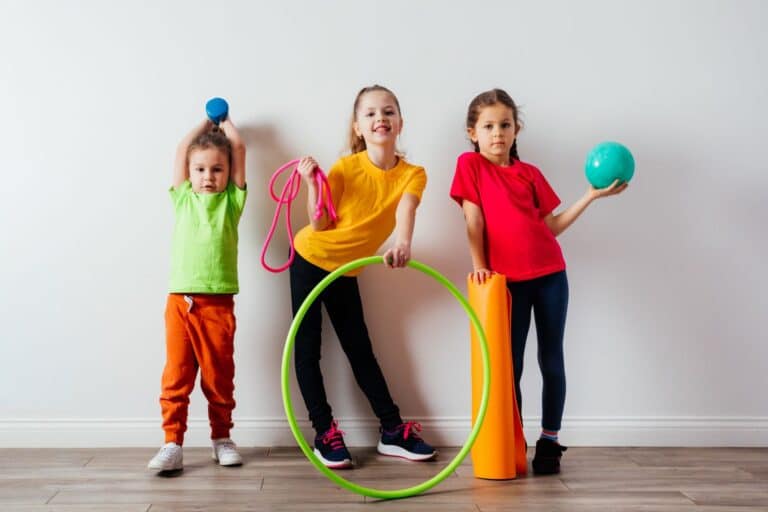
We have tried a lot of new things this year in PE with 1st and 2nd graders. The fun thing about those grades is that everything is new and exciting. They are game to try anything. On the other hand their attention span is shorter, so you can’t stick with the same thing for too long. I wanted to review some skills, but knew their attention wouldn’t last a whole day on these things; so I divided them up into stations then rotated the kids thru. I had five stations. I spent the first few minutes explaining what would happen at each stations and how to rotate when I blew the whistle. Then I divided them into groups and let them play. I rotated around and gave help as needed. These are the stations and the objectives for each one:
#1: foam balls and paddles: hand-eye coordination
#2: hoops on the ground, bean bags: tossing with accuracy
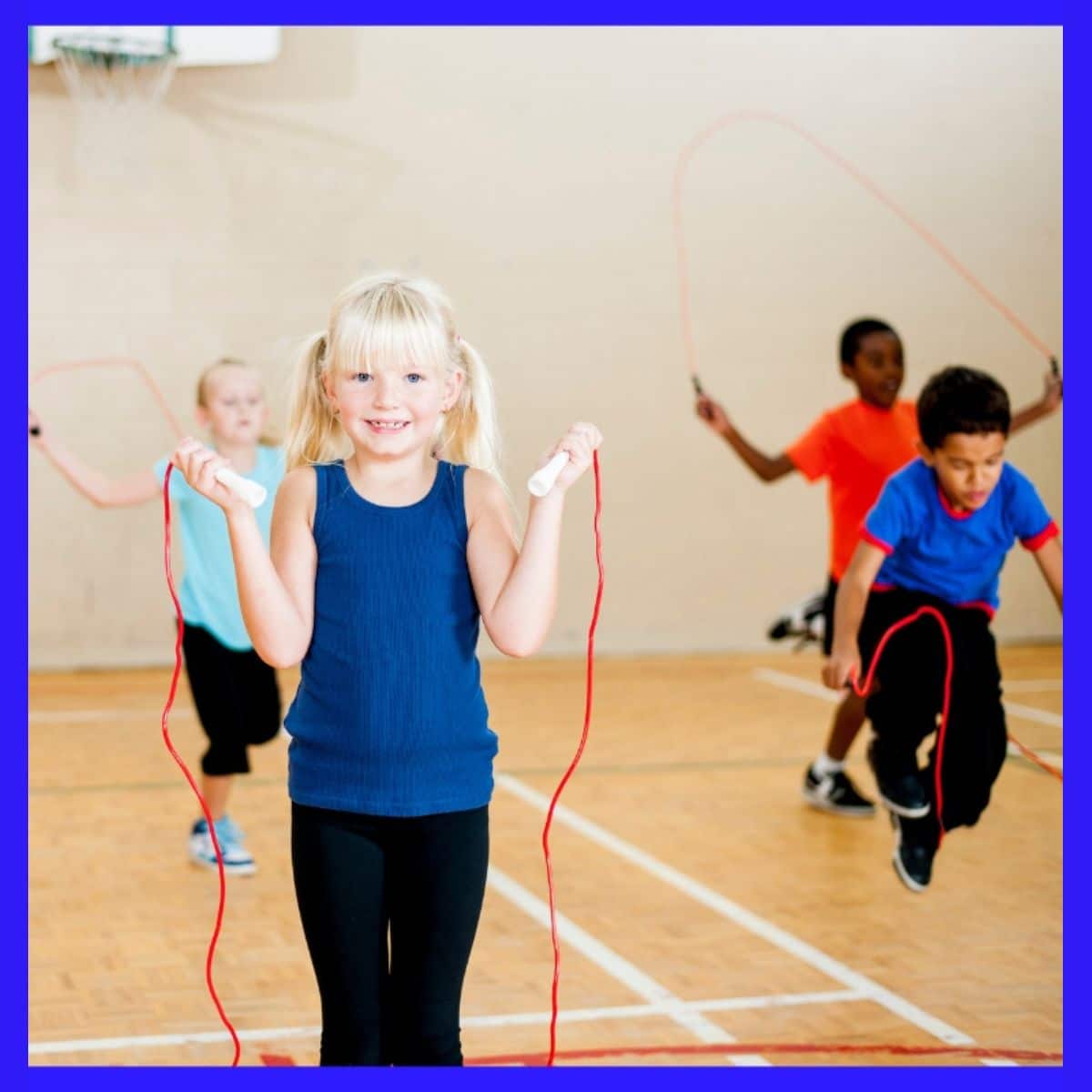
#3: jump ropes: fitness, jump rope skills
#4: hula hoops: fitness, jumping and spinning skills
#5: mats: fitness, tumbling skills, movement

The kids had a blast! They stayed engaged in their tasks and worked hard. They left the class sweaty and smiling – I love that!